 |
 |
 |
 |
||
 |
||
| Annual Report | ||
 |
||
 |
News | |
|
||
|
||
| MDRC Administration | ||
|
||
|
Directory / Bottin | |
|
||
|
Contact Us | |
|
||
|
Directions / Maps | |
|
||
|
Steering Committee | |
|
||
| Research | ||
|
||
|
Events & Seminars | |
|
||
|
MDRC at the forefront | |
|
||
|
McGarry Lecture | |
|
||
|
Cahill Lecture | |
|
||
|
MDRC Core Facilities | |
|
||
|
Scientific Links | |
|
||
|
Education & Employment | |
|
||
|
||
| Funding | ||
|
||
|
MDRC Grants | |
|
||
|
Donations | |
|
||
|
Non-Profit & Industrial Partners | |
|
||
| Medical Information | ||
|
||
|
JDRF | |
|
||
|
CDA | |
|
||
|
Diabetes Quebec | |
|
||
|
ADA | |
|
||
|
IDF | |
|
||
|
NIH / NIDDK | |
|
||
|
Alfediam | |
|
||
|
EASD | |
|
||
| Home / About Us > Dr May Faraj | 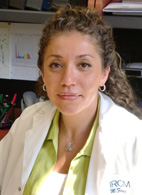
Contact info Dr May Faraj Tel: 1-514-987-5655
Research keywords
|
|
May Faraj, PDt, PhD
Associate professor of research, Department of Nutrition
Biographical Sketch
May Faraj obtained her MSc in Nutrition and her PhD in Experimental medicine from McGill University in Montreal under the supervision of Dr Katherine Cianflone. Her graduate work investigated the regulation of lipoprotein lipase activity, lipoprotein metabolism and fatty acid trapping in adipose tissue using cell, mice and human models. In 2004, she joined the lab of Dr Remi Rabasa-Lhoret, Department of Nutrition, University of Montreal, as a CIHR-postdoctoral fellow exploring insulin action and sensitivity in humans. In 2007 she obtained CIHR New Investigator Award and an academic position as an assistant professor/junior scientist in the Department of Nutrition, University of Montreal. She then joined Clinical Research Institute of Montreal (IRCM) in 2008 as an invited scientist, where she started her clinical research lab funded by CIHR operating grants and CFI leader's opportunity funds and in collaboration with Dr Rabasa-Lhoret and IRCM physicians. Most recently in 2013, she was awarded FRSQ salary support, Chercheure boursi�re � Junior 2, in Clinical and epidemiological research. Her research explores a hypothesis she instigated in 2006 linking the number of apoB-lipoproteins to the promotion and prevention of type 2 diabetes in humans. She is a member of L'Ordre Professionnel des Di�t�tistes du Qu�bec since 1999. Research Interests
The research of Dr Faraj focuses on investigating the hypothesis that elevated numbers of atherogenic or apoB-lipoproteins (measured as plasma apoB) may be a cause and not only a consequence of type 2 diabetes in humans. She examines whether apoB-lipoproteins may activate mechanisms that are known to promote type 2 diabetes in humans, and particularly in obesity, namely inflammation, dysfunctional adipose tissue, hyperinsulinemia and insulin resistance. Moreover, she investigates whether targeting subjects with the hyperapoB phenotype (i.e. elevated plasma apoB) by nutritional interventions may reduce plasma apoB and associated cardiometabolic risks in these subjects. To investigate these hypotheses, she utilizes complementary in vivo, ex vivo (adipose tissue) and in vitro (adipocytes and macrophage) techniques to follow the metabolism of dietary fat (stable and radioactive isotopes studies), to assess inflammation (cytokine secretion, immunohistochemistry and gene expression), to fractionate and characterize lipoproteins (ultracentrifugation, FPLC, gel electrophoresis) and to assess insulin secretion, sensitivity and action (Botnia clamp and insulin-induced glucose/lipid cellular metabolism). |
|
| � Montreal Diabetes Research Center 2018 |
| Home / About Us News Directory / Bottin Contact Us |